Eating Animals in an Anthropomorphic Culture
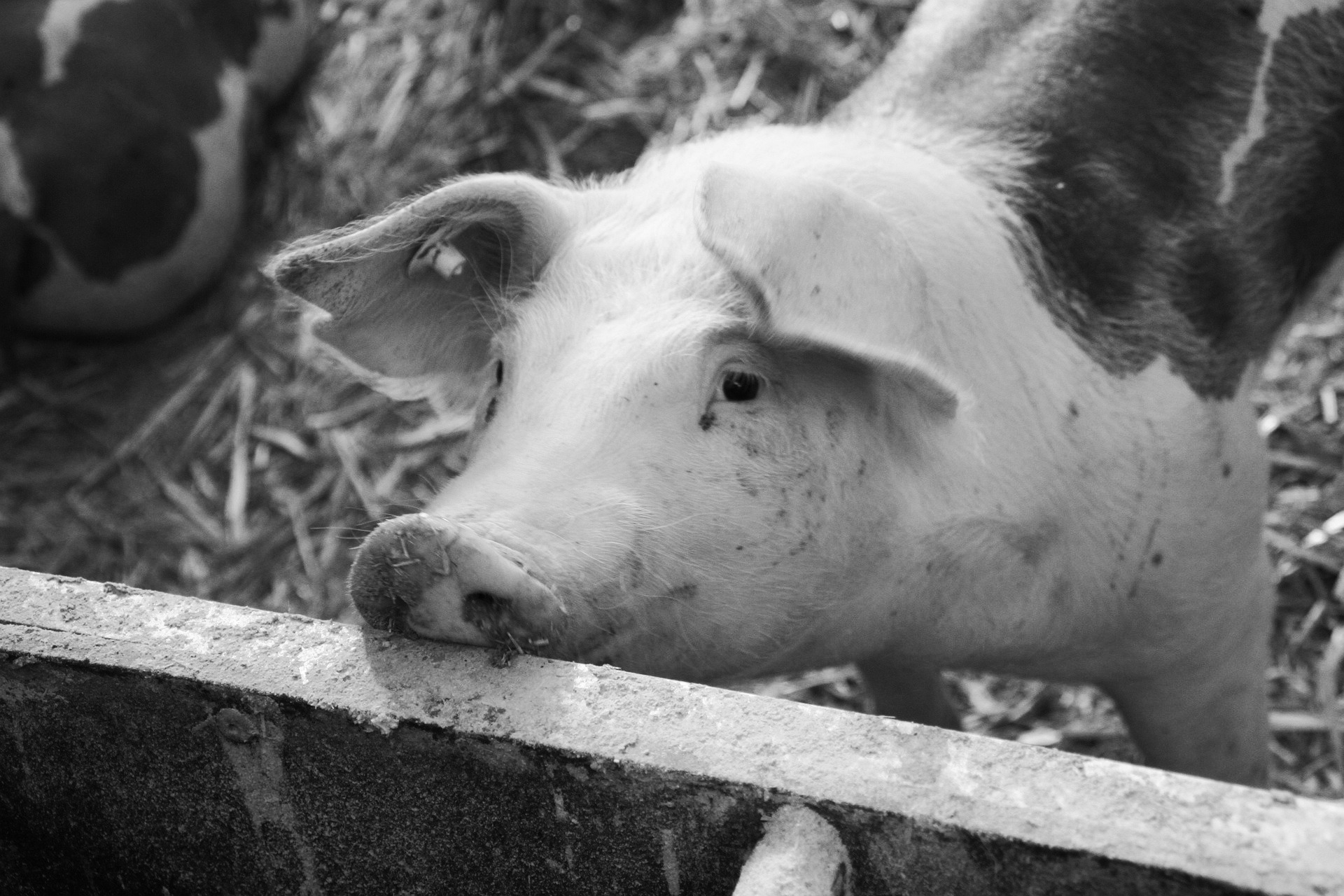
Every time I experience psychosis, I stop eating meat. Fish is the exeption, perhaps because I grew up to Kurt Cobain singing “It’s okay to eat fish, ‘cause they don’t have any feelings.” Or more likely, because I used to go fishing every summer with my dad, and we killed a lot of fish and ate it. I could not take a bolt gun to the head of a pig, hang it upside down in chains, and slit its carotid artery with a knife to leave it bleeding out. Unlike fish, the pig is an intelligent mammal that I identify with. I’ve seen Babe, the nineties movie that won my heart. I’ve seen images of pigs suffering in gestation crates in industrial farming. I’ve cheered for the little pigs outsmarting the wolf in Disney cartoons. For this reason, eating pork (or beef, or chicken for that matter) creates cognitive dissonance in me. On one hand, I believe that humans are omnivores – we’ve evolved eating meat and as such, it’s part of our genetic make up – but on the other hand I disagree with inflicting suffering on sentient beings, especially through modern factory farming methods. As seen from this perspective, meat is murder. How come I hold these conflicting beliefs and why do they always bubble up to the surface when I go mad?
Let’s backtrack a bit. I am a child of the culture I was raised in. Born in 1982, I belong to the early millenials that came of age in a time when animal rights exploded. In the nineties, Anita Roderick’s The Body Shop had expanded into a large chain that sold beauty products with the underlying ethos that none of their products were tested on animals. I used to go there a lot, and while browsing shampoo and lipgloss I came across brochures advocating for membership in animal rights groups. They were graphically shocking with pictures of rabbits immobilized in crates to prevent them from scratching their eyes during the Draize test – an ocular toxicity test to assess the irritation potential of chemicals that may come into contact with human eyes. Others showed dead mice that had been subjected to LD-50 tests, which explored the toxicity of substances at the point where fifty percent of the animals exposed died. I remember wondering how humans could be so cruel to our fellow beings.
At 19, I became a pescatarian and stopped eating all other meats than fish for five years. I lived in Norway at the time, where there was plenty of good fish to be had. I can’t remember why I started eating meat again, but I’d moved to a landlocked country and certainly had other things on my mind than the suffering of farm animals. Ignorance is bliss, but you can’t close your eyes to the fact that a five-year-old boy who watches Peppa Pig while munching down pork chops for dinner is in an ethical dilemma – he just doesn’t know it yet. He’s being taught to identify with the anthropomorphic animals while eating them. I don’t know what it does to your psyche, but judging from my disgust for eating meat when I’m psychotic – to the point where I equate eating pork with eating myself – it is not good. My view on animals would be very different to my grandmother, who was born in 1923. She grew up with actual farm animals and no TV while I grew up with Disney’s talking animals.
As my last psychosis ebbed out, I got curious about the origins of the animal rights movement that influenced me so much while growing up. While there are early outliers, the modern animal rights movement traces back to a small group of philosophy students at the University of Oxford in the early 1970s. The most famous member of this Oxford Group was the moral philosopher Peter Singer who published the seminal work Animal Liberation in 1975. Singer is a utilitarian who follows in the footsteps of Jeremy Bentham by arguing that the interests of animals should be considered due to their ability to suffer. He popularized the concept of speciesism – discrimination on the grounds that a being belongs to a certain species.
Surely humans are culpable of speciesism which explains the guilt I feel when I eat a burger, something I now as a meat eater once again rationalize with the argument that I’m simply an animal following my nature (plus, I’m deficient in iron). Have humans evolved so far that we should stand above our nature? It’s a tricky question. I was confronted with it again when I read Homo Deus, a speculation in mankind’s future by Oxford educated historian and vegetarian Yuval Noah Harari. He propses that Homo sapiens is on the brink of splitting into two species – where the classic one gets left behind by a new ubermensch, Homo Deus, who will be augmented by computer technology and genetic engineering. How Homo Deus will treat his old and inferior friend sapiens remains unclear, but judging based on how we treat our fellow animals we might be in for a surprise. At least according to Harari.